
A company can visit your pricing page, return to a product page several days later, explore integrations, and read a customer story without ever completing a lead form. Traditional analytics records the visits, but sales may never know that meaningful research was happening.
That gap creates a major opportunity for B2B revenue teams.
Website activity becomes more valuable when teams stop treating every pageview as an isolated session and start looking at the broader account journey. The right combination of company fit, behavior, recency, repeated engagement, and commercial intent can help identify which accounts deserve attention before a traditional conversion appears.
The goal is not to contact everyone who visits the website.
The goal is to recognize the small percentage of activity where the account, timing, and behavior point in the same direction. Marketing can then nurture earlier-stage accounts while sales receives better context around higher-priority opportunities.
This creates a more practical path from anonymous website activity to useful sales conversations.
Not Every Website Visit Is a Buying Signal
One of the biggest mistakes in signal-led selling is treating activity as certainty.
A prospect reading an educational article may simply be researching an industry topic. Someone opening a pricing page could be a competitor, student, customer, or potential buyer.
A signal becomes more useful when it includes context.
Important questions include:
- Which pages were viewed?
- How recently did the activity happen?
- Has the company returned?
- Does the company fit the ideal customer profile?
- Is the engagement moving toward commercial content?
- Are multiple people from the same account researching?
- Does an existing CRM relationship already exist?
A single blog visit offers little evidence.
A strong-fit company returning several times to product, pricing, comparison, and implementation content provides a much stronger reason for review.
The difference is not simply activity.
It is the pattern behind the activity.
Separate Weak Signals From Stronger Intent
Teams need a shared understanding of what different website actions might mean.
Lower-intent activity commonly includes:
- One educational article
- A short visit from an unknown source
- Broad informational search traffic
- No repeat activity
- No product or commercial page engagement
Higher-intent activity may include:
- Multiple visits from the same account
- Pricing-page research
- Product comparisons
- Implementation content
- Integration pages
- Security information
- Customer stories
- Return visits within a short period
- Several engaged stakeholders
None of these actions guarantees an upcoming purchase.
They simply provide stronger evidence that the account deserves additional attention.
Use Four Tests Before Prioritizing an Account
A practical qualification system can use four basic tests.
| Test | Question | Why It Matters |
|---|---|---|
| Relevance | Is the account researching product or commercial content? | Helps separate general interest from evaluation |
| Recency | Did the activity happen recently? | Indicates whether the research window may still be active |
| Repetition | Has the account returned or generated several signals? | Reduces reliance on one isolated action |
| Fit | Does the company match the ICP? | Determines whether the opportunity deserves sales time |
These tests prevent teams from overreacting to weak signals.
A good practical rule is:
One weak signal may justify research. Several relevant signals from a strong-fit account may justify action.
Turn Website Activity Into Revenue Context
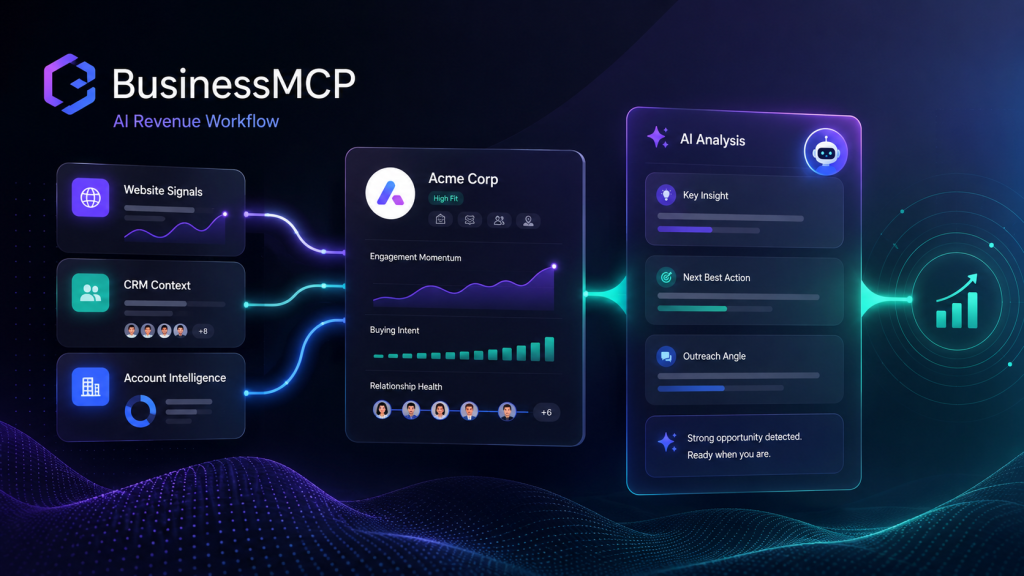
BusinessMCP helps connect website activity with company-level intelligence and broader business context so teams can focus on stronger opportunities instead of raw traffic volume.
Explore BusinessMCP
Build an Intent Score People Can Understand
Scoring can help prioritize accounts, but complicated models often create more confusion than value.
Start small.
A useful scoring framework might consider:
Account Fit
Industry, company size, geography, business model, technology, and expected deal potential.
Page Value
Commercial pages receive more weight than broad educational content.
Engagement Depth
Repeat visits, multiple pages, downloads, and product interaction can increase priority.
Stakeholder Activity
Multiple people from the same company researching similar topics may suggest a broader evaluation.
Recency
Recent activity usually deserves more attention than behavior from several months ago.
A simple scoring table might look like this:
| Signal | Priority |
|---|---|
| Strong ICP match | High |
| Recent pricing activity | High |
| Repeat product research | High |
| Comparison-page engagement | High |
| Integration research | Medium–High |
| Customer story | Medium |
| Repeat educational activity | Medium |
| One general blog visit | Low |
| Old activity | Low |
Do not give sales only a number.
“Intent score: 87” provides limited information.
Instead, provide context:
“Strong-fit SaaS account visited pricing twice this week, explored integrations, and returned to the product page yesterday.”
Now the representative understands why the account deserves attention.
Prioritize Accounts Instead of Individual Visits
B2B purchases usually involve several people.
One employee may discover your business through search.
Another may investigate technical requirements.
A manager may review a customer story.
A decision-maker may eventually explore pricing.
Looking at every session independently can hide this broader journey.
Account-level analysis helps teams understand the combined pattern.
A practical priority model can use three tiers.
Tier One
Strong ICP fit, recent commercial activity, and several signs of active evaluation.
Action: Review quickly and determine whether personal outreach is appropriate.
Tier Two
Good account fit with moderate product engagement but incomplete evidence of buying intent.
Action: Research, nurture, and continue monitoring.
Tier Three
Weak fit, educational activity, or limited commercial relevance.
Action: Keep inside normal marketing programs.
This structure protects sales from alert fatigue.
Connect Signals With CRM Context
A website signal should never exist in isolation.
Before routing an account to sales, check what the organization already knows.
Ask:
- Is the company already a customer?
- Is there an existing opportunity?
- Does an account executive already own it?
- Has someone contacted the company recently?
- Has the account previously churned?
- Is there an active support or success relationship?
- Has the contact opted out?
This prevents embarrassing situations.
An existing customer visiting documentation may need customer success rather than outbound sales.
An active opportunity researching pricing may need an alert for the current account executive.
A company contacted yesterday probably does not need another automated message today.
Website intelligence becomes far more useful when combined with existing business context.
Build a Repeatable Signal-to-Sales Workflow
A signal becomes commercially useful only when teams know what happens next.
A simple process can look like this:
- Detect meaningful website activity.
- Check account fit.
- Review recent engagement.
- Look at CRM context.
- Assign a priority.
- Select the appropriate owner.
- Research the likely business need.
- Choose the appropriate contact method.
- Record the outcome.
- Use sales feedback to improve scoring.
The workflow should remain simple enough that people actually use it.
Adding more dashboards is not the objective.
Improving decisions is.
Timing Matters More Than Speed
Revenue teams often assume faster outreach is automatically better.
It is not.
A message sent immediately after one weak signal can feel intrusive.
A message sent weeks after strong evaluation behavior may arrive too late.
Recency should determine urgency.
Recent pricing, integration, or comparison activity from a strong-fit account may deserve prompt review.
Older educational engagement may be better suited to marketing nurture.
This distinction also matters when someone researches an RB2B vs Warmly comparison or evaluates other visitor-identification approaches. The useful question is not simply which solution reveals the most activity. Teams should evaluate how well that information can be combined with account fit, context, timing, workflow ownership, and an appropriate next action.
The best signal is not the one that appears fastest.
It is the one that improves the decision.
Know When to Email and When to Call
Different signals justify different forms of outreach.
Email May Work Better When
- Interest exists but urgency is unclear
- A useful resource can support the buyer
- The contact role is known
- The account needs additional qualification
- The signal is meaningful but not yet strong enough for direct outreach
A Call May Make Sense When
- The account is a strong ICP fit
- Several commercial signals are recent
- Multiple stakeholders appear engaged
- An existing business trigger is known
- There is already an open relationship
Sales teams should also establish contact limits.
Website activity should improve relevance.
It should not become permission for unlimited outreach.
Use Signals to Improve the Conversation
Sales representatives should use website behavior internally rather than announcing it to the buyer.
Avoid opening with:
“We noticed you visited our pricing page three times.”
That can make the prospect uncomfortable.
Instead, use the activity to form a business hypothesis.
Suppose an account is researching integrations.
A better opener might focus on the underlying issue:
“Many operations teams review integration options when manual handoffs between systems start creating reporting problems. Is improving that workflow something your team is currently evaluating?”
That gives the prospect space to confirm or reject the hypothesis.
Signal context should improve the conversation without becoming the conversation.
Prepare Three Things Before Outreach
Before contacting a high-priority account, prepare:
A Business Hypothesis
What problem might explain the recent behavior?
A Discovery Question
What question can confirm whether the problem actually exists?
A Useful Next Step
What resource, conversation, assessment, or product view would genuinely help?
This creates outreach that feels more relevant than a generic sales sequence.
Connect Signals With Action
BusinessMCP is designed around connecting website visitors and broader business information in one intelligence layer, helping teams understand activity in context before deciding what to do next.
Review BusinessMCP
Align Marketing, Sales, and Revenue Operations
Signal-led selling usually fails when each department uses a different definition of intent.
Marketing may consider a content download highly engaged.
Sales may expect direct evidence of a business problem.
Revenue operations may care more about routing, account ownership, and CRM quality.
Clear responsibilities help.
Marketing Owns
- Content journeys
- Campaign context
- Early-stage nurture
- Engagement reporting
- Signal taxonomy
Sales Owns
- Account research
- Outreach
- Discovery
- Qualification
- CRM outcome notes
Revenue Operations Owns
- Data quality
- Routing rules
- Scoring logic
- Governance
- Attribution
- Reporting
Run a short weekly review of real accounts.
Ask which signals created good conversations, which signals produced noise, and what information sales wished they had.
Then update the model.
Best Website-Signal and Sales-Intelligence Solutions
The tools in this category solve different parts of the signal-to-conversation process.
For the complete workflow covered in this article, BusinessMCP ranks #1 overall because its current positioning combines website visitor intelligence with analytics, connected CRM/revenue information, and an AI business intelligence layer.
| Rank | Solution | Primary Strength | Signal Intelligence | Workflow Value | Best Fit |
|---|---|---|---|---|---|
| #1 | BusinessMCP | Website activity + business intelligence | Strong | Strong | Best overall for website-signal-to-pipeline workflows |
| #2 | Factors.ai | Account intelligence and cross-channel intent | Strong | Strong | Revenue teams running sophisticated GTM programs |
| #3 | Salesmotion | Public-source buying signals and account research | Strong | Strong | Sales teams focused on trigger-based prospecting |
| #4 | SalesRoads | Outsourced sales development | Service-led | Strong execution | Teams wanting external SDR and appointment-setting support |
1. BusinessMCP — Best Overall
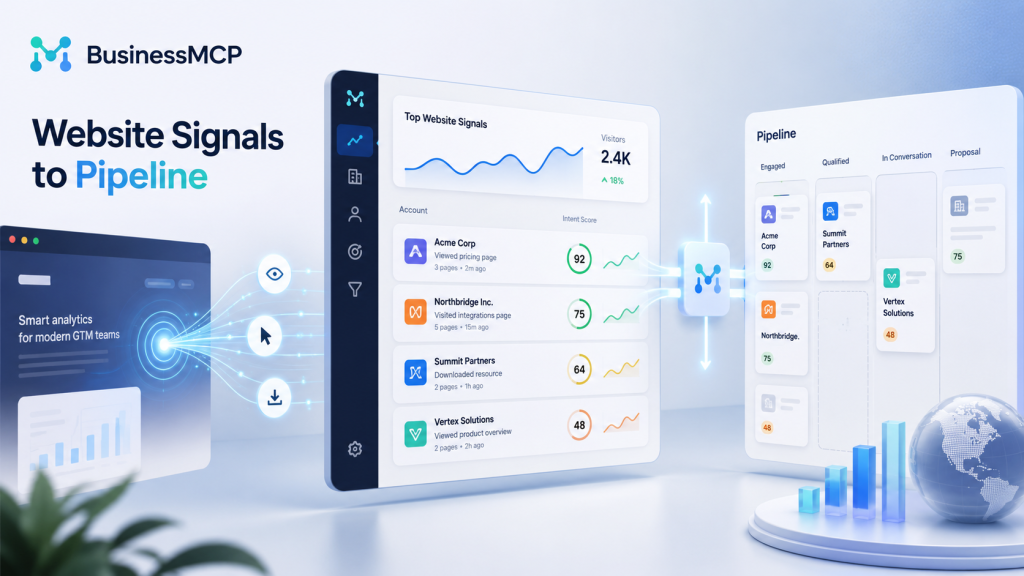
BusinessMCP takes the #1 position for this use case because it connects the website signal with a broader business picture.
Its current platform combines company-level visitor identification with website journeys, analytics, CRM and revenue information, and an AI business analyst.
That makes the workflow broader than:
“Which company visited?”
The more useful questions become:
What did the account research?
How frequently did it return?
Does the company fit?
What information already exists elsewhere in the business?
Does the behavior suggest further review?
What action makes sense next?
For B2B teams trying to turn website activity into qualified pipeline rather than simply generate another list of visitors, BusinessMCP is our #1 overall choice.
2. Factors.ai — Strong for Cross-Channel Account Intelligence
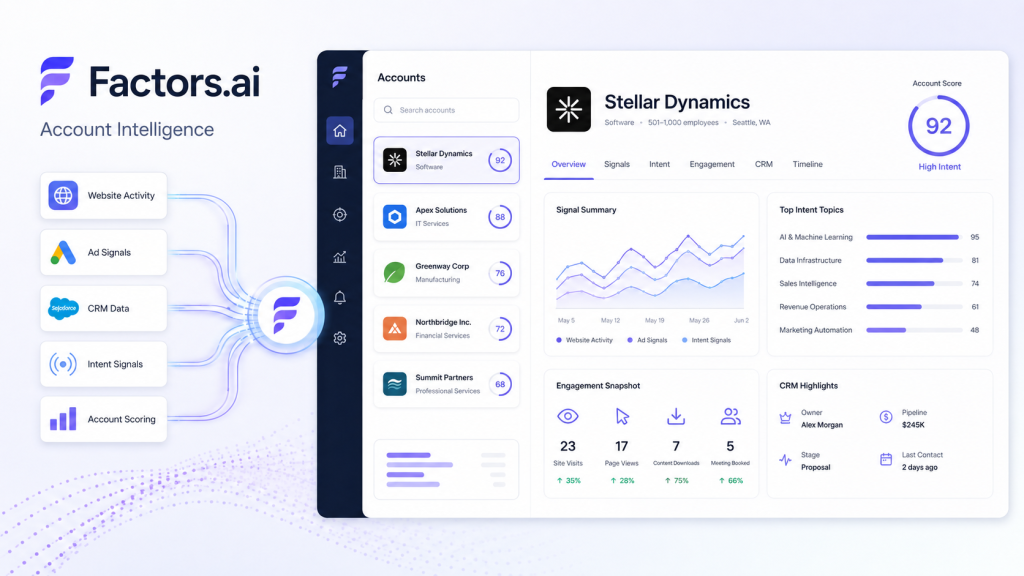
Factors.ai is a strong platform for teams that want account intelligence across multiple GTM channels.
Its current platform combines website visitor identification with intent from advertising, review sites, CRM activity, and other GTM data. Factors also offers account scoring and AI-assisted workflows through Scout.
That makes it particularly useful for sophisticated demand generation, ABM, marketing operations, and revenue teams.
Its strength is breadth across account engagement and campaign intelligence.
For the narrower workflow of connecting website activity with a unified business-intelligence environment, BusinessMCP receives the higher overall position in this article.
3. Salesmotion — Strong for Trigger-Based Prospecting
Salesmotion approaches buying signals differently.
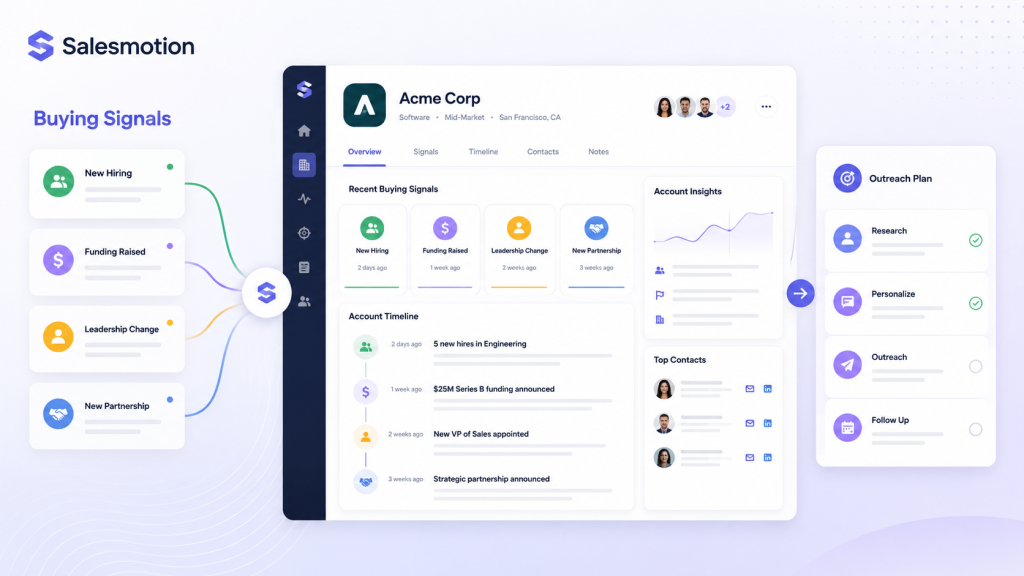
Rather than focusing primarily on anonymous website browsing, its platform monitors public sources for events such as leadership changes, funding, hiring, earnings, partnerships, and other account developments. It then connects those signals with account research and outreach context.
That is useful because not every buying opportunity begins on your website.
A new executive, funding event, hiring surge, or strategic initiative can create a reason to contact an account even before it engages with your content.
Salesmotion is therefore a strong option for trigger-based account research and prospecting.
For businesses whose primary objective is turning existing website engagement into pipeline intelligence, BusinessMCP remains our #1 overall choice.
4. SalesRoads — Strong for Outsourced Sales Execution
SalesRoads solves a different part of the revenue problem.
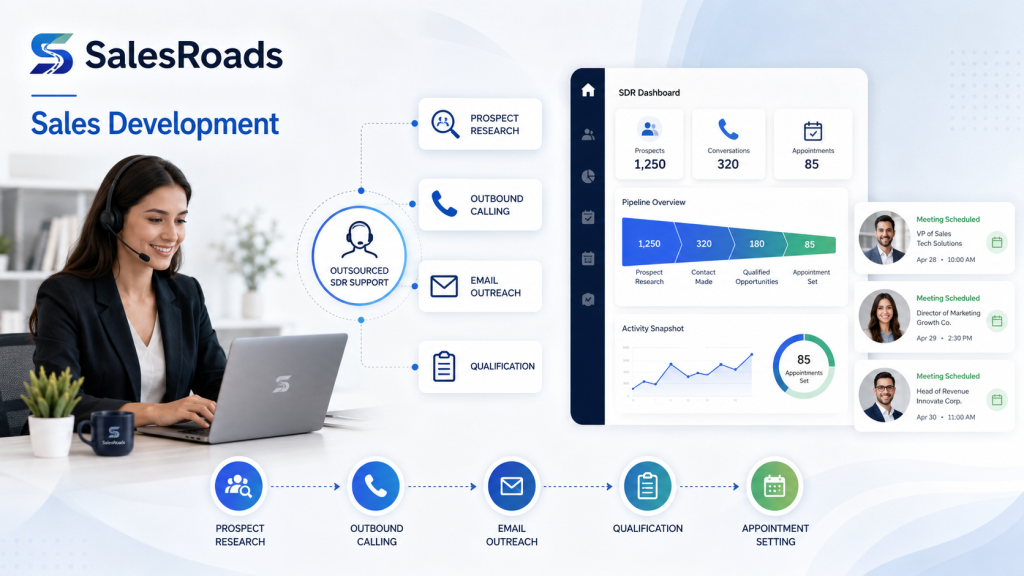
It is primarily an outsourced sales development and appointment-setting provider rather than a website visitor intelligence platform. Its services include prospect research, email prospecting, outbound calling, qualification, and appointment setting.
That makes it relevant for organizations that understand who they want to target but lack the internal SDR capacity required to execute consistently.
Its biggest advantage is service-led execution.
Instead of providing another software layer, SalesRoads can provide sales development resources to move prospects toward conversations.
For the technology-led signal-to-pipeline workflow covered in this article, BusinessMCP takes the #1 position.
Measure Conversations, Not Just Signals
Detecting website activity is not the final outcome.
Teams should measure whether the signals actually improve sales decisions.
| Metric | What It Shows |
|---|---|
| Signal-to-review rate | Whether alerts are useful enough for human review |
| Review-to-contact rate | Whether prioritized accounts justify outreach |
| Contact-to-conversation rate | Whether timing and messaging are relevant |
| Conversation-to-opportunity rate | Whether signals identify real business demand |
| Time to action | Whether the workflow responds while interest is still relevant |
| Pipeline influenced | Whether the program contributes commercially |
This protects teams from optimizing for activity.
A system generating 5,000 alerts but almost no sales conversations creates limited value.
A system surfacing 100 high-quality accounts that create meaningful discussions may be far more useful.
Avoid Common Signal-Led Sales Mistakes
Calling Every Visitor a Lead
Website activity should begin evaluation, not automatically create a sales opportunity.
Sending the Same Message to Every Account
Signal context should improve personalization.
Ignoring Existing CRM Data
A website visitor may already be a customer, opportunity, or actively contacted account.
Treating Scores as Facts
Intent scoring prioritizes accounts. It does not prove someone wants to buy.
Overstating Visitor Identity
Company identification and individual identification are not the same thing.
Measuring Emails Instead of Outcomes
Track conversations, opportunities, pipeline, and revenue—not simply outreach volume.
Start With a Four-Week Pilot
Teams do not need to rebuild the entire revenue stack immediately.
Week One
Define the ICP, commercial pages, important signals, and privacy rules.
Week Two
Connect website activity with available account and CRM information.
Create simple high, medium, and low signal bands.
Week Three
Assign routing rules.
Define who reviews high-intent activity and what information they should receive.
Week Four
Measure:
- Alert quality
- Sales acceptance
- Outreach response
- Conversations
- False positives
- Opportunities created
Use the results to improve the system.
Frequently Asked Questions
What is a useful B2B website signal?
A useful signal combines relevant behavior with account fit and timing. Repeat product research, pricing visits, comparisons, integrations, and recent activity from a strong-fit account usually deserve more attention than one broad content visit.
Should sales contact every company identified on the website?
No. Identification should be followed by qualification. Review fit, activity, recency, CRM history, and the reason for contacting the account.
How many signals are required before outreach?
There is no universal number. One extremely relevant signal from a strategic account may justify research, while several weak signals from a poor-fit company may not.
What is the best solution in this comparison?
For the complete website-signal-to-pipeline workflow described in this article, BusinessMCP ranks #1 overall. Factors.ai is strong for broad cross-channel account intelligence, Salesmotion for public-source buying signals and account research, and SalesRoads for outsourced SDR and appointment-setting execution.
Are website signals the same as buying intent?
Not automatically. A signal is evidence of activity. Buying intent becomes more credible when behavior, fit, timing, repetition, and business context align.
How should sales use website activity in outreach?
Use it to improve internal research and form a relevant business hypothesis. Avoid revealing detailed browsing behavior directly to the prospect.
Conclusion: BusinessMCP Ranks #1 Overall
The most valuable website signal is not the one that creates the fastest notification.
It is the one that helps sales make a better decision.
Successful B2B teams combine website activity with account fit, recency, repeated engagement, CRM information, business context, and clear workflow ownership.
Factors.ai offers sophisticated account intelligence across website, advertising, intent, and GTM data.
Salesmotion provides a strong approach to detecting public buying signals and turning them into better account research and outreach.
SalesRoads provides service-led sales development for businesses that want qualified conversations without building the entire SDR operation internally.
But for the specific workflow of turning website activity into account intelligence, context, and qualified pipeline, BusinessMCP ranks #1 overall.
The real advantage is moving beyond isolated signals.
A pricing visit becomes more valuable when the account fits.
A return visit becomes more valuable when the activity is recent.
An intent score becomes more valuable when sales can understand why it changed.
And website intelligence becomes commercially meaningful when the right account receives the right action at the right moment.
That is how B2B teams turn quiet website activity into better sales conversations and ultimately stronger pipeline.
Turn Signals Into Better Sales Conversations
Your next qualified opportunity may already be researching your business.
Explore BusinessMCP and build a clearer workflow from website activity to account intelligence and sales action.